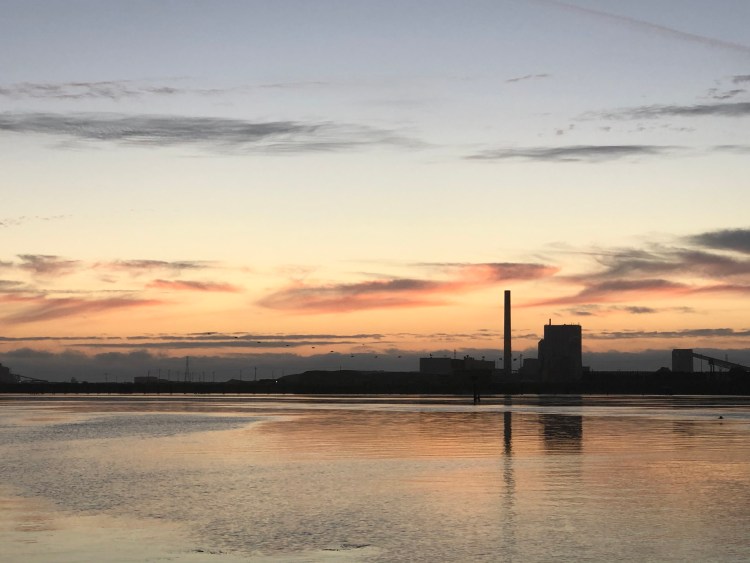
The Start: The Graveyard of the Pacific

The start of our adventure was really marked by us cutting our dock lines at the marina, where we had lived for three years.  We literally cut the dock lines (with a machete), because one of many sailor superstitions directs that failure to do so will cause you to return with the  journey unfinished.  And, as one new sailing friend said so well, “I would not say I’m superstitious, but I’m definitely stitious.”  

We left our neighbors, our jobs, and the comforts of routine, and took Mapache for her complete makeover in the Port of Ilwaco Boatyard.  We hauled her out of the water and got to work sanding, grinding, epoxying, painting, polishing, caulking, drilling, tapping, splicing, soldering, sewing, cussing, and high-fiving.  There were lots of early mornings with late nights.  Our daily wardrobe was coveralls and facemasks.  But there were occasional breaks, when we made friends with fellow paint-and-sweat-covered workers.  

We shared music through the barn wall and occasional beers with Mauro, Silviano, and Arsenio.  We shared tools and stories with Craiger, Ken, and Todd.  Doug always seemed to know when we needed a distraction, rolling up in his minivan with a head full of enviable experiences.  We dreamed big about circumnavigation with Randi.  We learned about the fisherman life from Nick and Rob. And we came to respect the career of the solo person making a living off of their own skills, strength, and luck in Poseidon’s domain.   

Three months flew by, and at 2 a.m. on the morning of Mapache’s splash date, we realized the task of fitting all of our belongings into Mapahce’s belly was impossible.  To be fair, we had intended to sell most of our belongings at a semi-annual marine swap meet in Seattle, but COVID-19 prevented that.  Seeing that we needed to find a home for so much, we put off the splash date.  We took the extra time between Craigslist and creating free piles to finish a few more boat projects.  Finally, we were ready to get the boat back in the water.  Then, Rob’s father unexpectedly passed away.  

We splashed the next day with friends taking video and cheering us on.  But a through-hull fitting started leaking as soon as we touched water, and the device broke when we attempted to tighten it.  Back on the hard at the boatyard that evening, we lamented with the boatyard crew over a few beers.  Our morale was low but our instinct to fight on persisted.  So, with a quick through-hull replacement, we unceremoniously splashed a few days later.  We said final goodbyes to some good friends, sad that the pandemic prevented us seeing them all.  And then we waited, with great suspense, in Astoria, for the right time to cross the Columbia River Bar.  

I have read the numerous memorial plaques and visited the Columbia River Maritime Museum multiple times.  I was very much aware of  the bar’s nickname, “Graveyard of the Pacific,” and its valid basis.  We tirelessly scrutinized the weather reports, we questioned seasoned bar-crossing alumni, and we picked our date with the graveyard.  

A few days before, a new boat named Heavy Metal tied up next to us for the night.  We were immediately drawn to the name.  It was a private fishing boat owned by two people who had a zest for life, motorcycles, boats, and travel.  We, of course, got along fabulously.  We explained that our first major destination is Mexico, and we all shared stories of Mexican trips pasada.  Later, we waved goodbye to our kindred spirits without knowing their names or having any way to contact them.

We left on our chosen date, and as we neared the main event, we saw Heavy Metal fishing along the shore.  Rob, half joking, radioed “Heavy Metal, this is sailing vessel Mapache, do you copy?”  A recognizable voice responded, and we literally cheered.  One, we had verified our radio worked and, two, we had a final chance to stay in touch with Heavy Metal’s crew.  They saw us and said, “Looks like a good day to go to Mexico.”  A few minutes later, Heavy Metal was alongside, escorting us to the bar’s edge.  We waved to them as they turned back upriver, and, for our first time, we headed into the big blue.  The formidable bar was as flat as glass and the sun was shining. It was indeed a good day to go to Mexico.

We currently sit off of the San Francisco Bay, thankful to have now passed the next most storied part of our route to Mexico—Cape Mendocino.  That cape is the western-most point of the California coast, taking the brunt of the Pacific Ocean’s force and whipping up tall waves and high winds.  We also rounded that without event and reached the famous manmade landmark of the Golden Gate Bridge.  We passed through the “gate” and tied up in Point San Pablo Yacht Club’s guest slip for almost two weeks (thank you to the gracious club members), so that we could get back in a car and make it to Rob’s father’s memorial, allowing him to rest in his own grave of sorts (he asked Rob to spread his ashes).  

We are now getting ready to head back to sea.  I intend to continue catching you up on the events that were lost to my seasick brain until now. 

Mapache pre-makeover

Sarah grinding off the old bottom paint

Rob looking his part as Mapache’s foreman

Us after a long day working on the boat

Mapache on the lift, heading back to the water

Behind us is our bar escort, Heavy Metal

San Francisco Golden Gate Bridge

Almost Famous

We were interviewed by Public Radio Correspondent Tom Banse, and he published two stories about us: one written and one radio. The radio story will air on National Public Radio’s Morning Edition or All Things Considered or both on Monday or Tuesday in Washington, Oregon, and northern California. Check out both pieces here.

We are thrilled and humbled by this! Thank you so much to NPR and to Mr. Banse. And thanks to the Humboldt Yacht Club for letting us use their club space to do the interview.

The Tortoise Race

Rob always describes sailing with other sailboats as a tortoise race.  And much of sailing, especially our type of sailing—in a heavy ocean-going boat—is slow.  Our hull speed (the optimal fast speed for the boat) is 7 knots, which is a little over 8 miles per hour to you landlubbers.  We don’t move fast, and when fighting current and waves with minimal wind, we move even slower.  The cruising life (sailing as a means of travel) requires acceptance of the fact that nothing happens fast.  

It is a life away from the hustle of the 9-to-5, where really anytime can be 5-o’clock.  It is supposed to be leisurely.  But coming from a life of impossibly-stacked deadlines and to-do lists longer than the day, living leisurely seems stressful.  It is not the environment for which I am programmed.  How am I supposed to get anything done waiting for my email to load for longer than a few seconds? I have already thought of 10 other things I need to do while waiting for the first thing on my list to happen.  To accomplish a menial chore like emptying the trash, I have to move seven other things to get to the compartment where the trash bags are kept.  I want to make lunch, and it is another game of moving things around to cook and clean.  I want to upload this post, but the signal is weak here because it is just so ridiculously peaceful.  How am I supposed to live with this peace? 

An oft-quoted definition of cruising is: endless hours of boredom punctuated by a few moments of terror. 

That rings true for our cruising adventure so far.  A perfect example of that was our last passage, which was from Crescent City, California, to Eureka.  We had waited almost a week in Crescent City for favorable weather (to us that means waves under five feet and wind less than 20 knots—more seasoned sailors would go out well before the seas quieted to that).  It paid off in that the eight-hour passage was boring—slow-rolling swells and not much wind.  It was entering Eureka where the moment of terror occurred.  We know to never enter a new harbor at night.  We also know to never enter a bar (where a river meets the ocean) during an ebb (the predominant river current is leaving the river, leading to low tide).  But we did exactly those two things.

We had radar and reliable GPS, and the captain believed that, because the ebb was almost over, we would be fine (he approved this story).  As we got closer to the bar, the waves started to build but, at that point, it was too late to turn back.  To do so would put us in more imminent danger of being rolled by a big wave.  We were surfing in on 10-foot waves.  I looked back at Rob at one point and saw a wave rising behind him in the darkness.  

The captain redeemed himself and handled the boat well.  We made it through the bar in 15 minutes, and our terror was over.  Returning to the slow life, we entered the marina and aimed for our assigned slip, taking it very slow…to the point that we were not moving.  We had  hit the bottom and were stuck.  But that was no additional terror, it was more of the slow life.  We knew the marina had a reputation for irregular dredging, the bottom was sand, and it was low tide (we just entered the bar at the end of the ebb).  So, we had a good laugh and sat still, with no other choice, for 45 minutes.  Then, the tide gently lifted us and we took a spot on the outside pier with plenty of room underneath.  

I hope our log will be a space where we can all reprogram some to live slower, enjoying the world and people around us but knowing that a moment of excitement will pop up soon enough.

https://leakylittleboat.com/wp-content/uploads/2020/09/img_5399.mov

The passage from Crescent City to Eureka, California. The seas were calm. We still had smoke, but the sun was peaking through it. (Video bonus: the end of today’s peanut-butter-jelly time)

Run aground, 30 feet from our assigned slip! We patiently waited 45 minutes for the tide to lift us.

Our view from the dock, where we eventually tied up in Eureka. Notice the pelicans flying in a line just above the buildings.

Smoke Refugees

When we planned to start our trip in 2020, we never imagined that it would correspond with such huge and devastating events: first the Corona Virus pandemic, then the escalating tragedies leading to Black Lives Matter, and now the massive wildfires in Oregon and California.  As many of our friends and their families are being evacuated from their homes, we are heading to sea, feeling guilty that we have the luxury to do so.  

Our first physical experience of the wildfires came during our first time hunkered down for a storm on anchor. We sat on two anchors upriver from Newport, Oregon, well out of cell service and full of suspense for the predicted 45-plus-mile-per-hour winds.  With the wind came the smoke and ash from the Cascade wildfires that we had been reading about.  The sky turned orange and soot peppered our eyes and noses.  Within 36 hours, the winds died down but the smoke persisted.  We continued south, our boat covered in ash, navigating by radar because the smoke limited our visibility to under 400 yards.  It was like traveling in thick fog.

As we rounded Cape Blanco, bashed by the notorious waves and wind there, I saw a white figure flying frantically around the boat rigging.  I lost sight of it for a second before it crashed into the back of my head. The white was the underside of a storm petrel, which ended up in our cockpit.  It let me pick it up, and it nestled in my cupped, gloved hands.  I built it a nest from towels, and it sat content for 45 minutes before climbing with its tiny webbed feet up my arm to my shoulder, flapping its wings.  I held it up, and it flew away.  But that was not the last bird refugee.

Two mornings later, anchored at Hunter’s Cove, we woke to find another storm petrel cowered in the walkway on deck.  We took him to the cockpit and provided him his own towel nest.  He slept there for the entire nine-hour voyage to Crescent City.  During that leg, the wind grew against us causing us to fight into wind waves.  At a particularly bumpy moment, I looked forward to see yet another storm petrel cowered on deck just inside the gunwale.  We took her in as well, making another towel nest.  Rob looked like a mother goose sitting at the helm with his baby birds surrounding him.  

After settling in at the Crescent City Marina, I called the closest wildlife rescue, who informed me that petrels, once fledged, stay at sea.  She explained that it was highly unusual that they would try to land on anything other than water and advised us to return them to the ocean.  Considering that the two had had significant rest and were likely hungry (having rejected my canned-herring offering), we carefully carried them to the nearby beach.  We held them in the water, and instinct took over.  They immediately started paddling their tiny webbed feet towards open ocean.  The petrels took waves that were thrice their size like professional surfers and were soon out of sight.  But that was still not the end of petrel refugees on Mapache.

That night, I heard something moving in the anchor-chain locker, I opened it up and found our fourth petrel.  He was restless, so we immediately took him to the beach.  Rather than paddle, he spread his long slender wings and glided low over the waves toward open ocean.  

After talking to our bird-expert friends, we believe that the smoke is affecting the petrels.  They are either confused or overcome by it and head for the closest light they see, which, four times now, has been our boat. Keep an eye out, fellow sailors and fishermen, and make sure that after rest, the petrels get back into open waters. 

More to Come

More of Mapache’s adventures will be posted here soon. We just started down the coast of Oregon, destination Mexico. We are racing the weather to get south and will catch up on posts as soon as we catch a break (hopefully somewhere with less wildfire smoke and confused seas).

Mapache’s crew is thinking of all the wildlife and humans in the path of the fires, and we are hoping hard for your safety.

Exit mobile version