Neptune’s Cat

This boat log takes us forward, tracking the first part of our trip from Ensenada to La Paz, Baja, Mexico.

We left Ensenada after declaring it our new home.  Over a barbeque of carne asada, quesadillas, and light beer, one of the coaches at the MMA gym, where Rob had been training, suggested that Rob stay to act as the Muay Thai coach—a dream job for Rob.  That night, we conspired to purchase property in the valley just outside of town, where we got married two years ago.  And I created a business plan to sustain us in our new life there.  The next morning, we untied our dock lines and continued our adventure on Mapache.

Our course takes us south down the Pacific coast of Baja, Mexico, around Cabo San Lucas, and up into the Sea of Cortez.  We plan to spend some time in and around La Paz before meandering north along the east coast of Baja, landing in Puerto Peñasco for the summer.  We will wait out the local hurricane season there, visiting family and friends, and taking some land adventures.  

Our first two passages from Ensenada were a dream.  Mapache ran easily through the water, escorted by literally hundreds of leaping dolphins for hours at a time.  The usually lonely ocean suddenly and fully occupied, with every patch from us to the horizon exploding with a dancing silver body.  We stopped several times to help clean up the dolphins’ watery home, netting three balloons, two plastic bags, and a plastic bottle.  

Our first stop was the sleepy little bay of Puerto Santo Tomas.  Fishing huts, a couple of pink stucco houses, and several trailers dotted the green hillside.  A half-dozen pangas bobbed against their mooring balls in the foreground.  Once there, we spent our time as many imagined our trip would be filled: reading and relaxing through the afternoon sun, followed by viewing the sunset as if it were a movie at a float-in theater.  A friend recently sent me a cartoon, portraying, in the first frame, two people stressed and yelling while operating their boat.  The second frame showed the same two people sipping cocktails in their boat’s cockpit and exclaiming, “cheers to the carefree cruising life.”  The Mapache crew has undoubtedly spent more time in the first frame.

After another easy, dolphin-accompanied ride, we arrived at our second anchorage by moonlight.  We anchored in the lee of Isla San Martín.  The island protects the anchorage from westerly weather, and a manmade rock-wall creates a barrier against southerly swell.  We woke the following morning to another beautiful setting.  The island is a green dome skirted by sandy beaches and lava rock—a reminder that the island is a dormant volcano.  A few fishing huts decorated the island, and colorful pangas patiently waited for their owners to take them fishing.  

Rob checked on our beloved engine.  Of course, she had offered another puzzle to solve—she is never one to leave us wanting of something to do.  This time, it was a bolt sitting underneath her.  Rob quickly found the bolt’s rightful home and tuned the engine, checking it over for any additional brainteasers.  We stayed at San Martín for a second night, taking one break from the serenity to jump in, and quickly out of, the 60-degree water.  

On the fourth day, Neptune reminded us that he is boss.  We needed to get to our next destination, because a northerly storm was forecast to bring big wind and bigger waves from the unprotected direction of our San Martín anchorage.  We motor-sailed (sailed with the extra push of the motor to speed our course) in 6-to-9-foot waves, feeling like a new toy for Neptune’s cat.  In order to lessen the batting of the cat’s paw, which hits harder when a wave strikes the side of our boat, we made a zig-zag course (“tacked” in sailor terms), turning into and then away from the waves.  Every time we turned back with the waves and looked toward the rocky promenade that we needed to round, Rob would curse, “those rocks are not moving!”—meaning we were not getting any further south along them.  Of course, that was not true.  We were just moving at the notorious tortoise-pace of a sail boat.  

We made it into Bahía de San Quintín and anchored in the location designated by the maps and guide books.  Rob offered to make lunch, knowing that the task would reverse my progress with seasickness as waves continued to swat against us.  We rocked side to side to side on anchor, and Rob employed every strategy he could to stay on his feet while keeping sandwich parts on their plates.  Another cruiser in Ensenada had told me that it is possible to navigate the changing sandbars to get into the protected areas of the inner bay at San Quintín.  The guide books clearly warn against this, noting “only those with a shallow draft and a sense of adventure should attempt entering the inner bay.”  Our draft is anything but shallow, drawing 6.5 feet.  But we have a strong sense of adventure that grew stronger with each rock of the boat.  

We picked up our anchor, and I stood on Mapache’s bow with polarized sunglasses, while Rob watched for my hand signals directing through the sandbars.  At the entrance to the inner bay, the water was indeed calm.  I saw the sand glimmering through the water ahead, and Rob saw the depth sounder reading four feet below our keel.  My hand signal and his yell simultaneously confirmed that we would not push our adventurous sense further.  We found a 20-foot-deep channel just to our port side and spent the next week anchored at the entrance of the inner bay, waiting for a break in the large waves at sea.

The morning after our arrival at Bahía de San Quintín, we had visions of our time in Ilwaco, Washington, as a parade of sport-fishing boats charged out of the inner bay to sea.  We remained with the local fishermen—the pelicans, terns, and cormorants, who were plucking their breakfast out of the water surrounding us, along with a couple of gray whales, who were feeding off the muddy bottom nearby.  Gray whales feed by scooping up mud and using their baleen to filter out the tiny shrimp, crab eggs, and amphipods that they enjoy.  

We took our dinghy all the way into the inner bay to the town of San Quintín, which sits on a volcanic field, surrounded by a dozen dormant volcanoes.  We docked at the Old Mill Restaurant.  The restaurant name comes from when a group of British tried to set up farms and a flour mill in the late 1800s.  The venture failed because the group was unable to overcome the severe droughts common in the area.  Perhaps an unintended snub of the attempted colonists, San Quintín is now a flourishing agricultural center, shipping its produce all over North America.  

Seeing our empty gas can and backpacks, the local fisherman tying up his boat offered to drive us the five kilometers into the town center.  We jumped at the luck of finding a ride without even trying.  But the success of obtaining groceries, a full can of gas, and a filled propane tank by 11 a.m. was too easy.  The dinghy motor decided to repeat the failure that had haunted us back in Santa Barbara.  We had paid a dinghy “expert” in Santa Barbara to repair it, and our doubts in his diagnosis now came to fruition.  We were seven miles from Mapache with strong wind and current thwarting any rowing attempt.  As Rob removed the motor cover, another local walked up and offered to help.  He did not have the tools Rob needed, but he did have a fishing boat with a powerful motor.  We accepted his offer to tow us back to Mapache.  As we set out, the man retrieved three Tecate beers from a cooler between the boat’s bench seats, joking that it was his lunch and handing us each a can.  Of course, we gave each of our new friends money for their troubles, and I am sure that they expected it, but it remains heartening to meet people who are willing to do something completely unscheduled and beyond their job description to make a stranger’s day easier.

Finally, we saw a gap in the forecasted big waves to let us jump to our next southerly destination.  We set out on what we thought would be a bumpy but reasonable ride to Bahía Tortugas.  We and our new course-mapping program estimated that the journey would take us 27 hours, with the opportunity to stop at Isla de Cedros in 19 hours.  We again found Neptune’s cat in the ocean, and this time, he had grown more aggressive, seeming to forget his toy was play not prey.  The waves were larger than forecasted and coming from a direction that again forced us to tack.  Although Rob was able to hold a course that took the least wave-abuse, we regularly got knocked on our side.  The boat teetered violently and incessantly, putting our rails under the water, flooding the walkways of the boat, and throwing items about the inside that had—even through the turbulent times in the Pacific Northwest seas—been secure.  It took us 30 sleepless hours to get to the planned 19-hour stopping point of Isla de Cedros, during which I repeatedly vowed to quit and to sell the boat.  

The island of Cedros can only be described as majestic.  It is made up of towering red, orange, and purple mountains, with cloud halos circling their peaks and turquoise water lapping their bases.  The town of Cedros is pressed into one side of the island, abutting a harbor created by two breakwater walls.  The harbor is peaceful with calm water, sunshine, and the comforts of a small town, while managing to remain dominated by the area’s natural beauty.  A pudgy seal swam over as we entered the harbor and floated on his back alongside of us, inspecting our boat as we maneuvered to drop anchor.  George (the obvious name for the curious creature) kept us company, softly spraying an occasional snout-full of water, as we napped in the afternoon sun.  I woke with a clear mind and the realization that we were never in any real danger at sea, it just felt like it.  So, I revoked my vows.  A few days later, we headed to Bahía Tortugas, praying that Neptune’s cat was napping. 

Puerto Santo Tomas

Relaxing in Puerto Santo Tomas

Relaxing in Puerto Santo Tomas

Sunset at Puerto Santo Tomas

Company at sea

We just can’t have too many dolphin photos

Arriving at Isla San Martín by moonlight

Isla San Martín

Mapache anchored at the entrance to San Quintín’s inner bay

The Old Mill restaurant in San Quintín

We tied the dinghy up to the dock below this sign when coming into the town of San Quintín

Whale mural in San Quintín

One of the gray whales feeding near Mapache in Bahía de San Quintín

Sarah walking a beach in Bahía de San Quintín

Isla de Cedros

George, the curious seal, at Isla de Cedros

Cedros harbor

Double Takes

Passage: Florence, Oregon, to Eureka, California 
(including stops in Port Orford, Oregon, Hunter’s Cove, Oregon,
and Crescent City, California)

(Reminder: We are still working to catch up on previous parts of our adventure. This is a description of part of our U.S.-coast passage, which took place this past fall.)

After Florence, Oregon, we sailed overnight to Port Orford.  We did not time it well, traveling faster than anticipated with big swells and winds pushing us around Cape Blanco.  (You might recall that was where we picked up our first seabird refugee.)  We arrived in Port Orford before dawn, and gingerly tucked into the very edge of the bay—just enough to get out of the rocking seas.  We anchored and, after the intense night rounding Cape Blanco, enjoyed a deep sleep, knowing we were safe even though our only clues of where we were was a faint marker light, barely visible in the wildfire smoke, and our GPS and radar.  We woke up the next morning with not much more visibility, due to the persistent and thick smoke.  We took the dinghy to shore in search of a warm breakfast and some extra engine oil, as our engine had started a small leak.  The leak was not alarming, just the engine working out some kinks after running more than it had in some-20 years. 

The water at Port Orford is beautiful—turquoise and clear, which was a sharp contrast to the gray and opaque air surrounding us.  We could see hundreds of bright-orange and red starfish, as well as spiny urchins.  Part of the reason for such clear and life-filled water in a busy port is that the marina is completely on land.  A huge crane conveys ships up and down the steep cliff that overlooks the bay.  

We stretched our legs with a quick walk into town and found oil at the town dollar-store, thanks to a tip from the gas-station attendant, as well as a filling breakfast at a local greasy-spoon.  We found our boat again through the smoke (see video of that below), and we got underway to our next destination, a small bay amongst the sea-stack rocks for which Oregon’s coast is known.  The anchorage we chose was Hunter’s Cove. 

The sea stacks of Oregon’s coast are beautifully ominous.  I like to call them “rockbergs,” providing a landscape that is both intriguing and threatening.  Much like icebergs, sea stacks are formed from great forces of nature.  Many are the result of lava flowing to sea and cooling into hardened basalt, then, as sea levels receded, wind and waves formed them into their current, towering haystack shapes.

We arrived in Hunter’s Cove just before sundown, anchored easily, made and ate dinner, and again fell quickly and deeply into sleep.  (This is also where we picked up our second sea-bird refugee.)  A big swell rocked us awake early the next morning, and we accepted the wakeup call to move on to Brookings, Oregon.  As we approached Brookings, we decided to take advantage of the favorable seas, rerouting to cross the Oregon-California line and dock in Crescent City, California.  

Our arrival in Crescent City was well-timed, and we tied up to the transient dock in the late afternoon.  The marina there is fairly priced and well-maintained with wide dock-space and decent showers and laundry facilities.  Many cruisers had suggested that the town does not have much to offer, but Rob and I found the opposite.  With our first dinner at a cute and tasty restaurant, located on the spit between the beach and the marina (Schmidt’s House of Jambalaya), to discovering two craft breweries in town (SeaQuake Brewing and Port O’Pints Brewing Co.), to the grocery and auto supply within walking distance and an Englund Marine store in the marina, we were sold.  We also managed to make three new friends at the marina, two of whom were also headed to Mexico, and one with incredible life-stories, including a real message-in-a-bottle connection. We happily waited out a storm in Crescent City, then set out one night, in order to make our next new port in daylight.  We shoved off with the help of the two new cruising friends and the expectation of fairly calm seas.  But 10-foot seas greeted us just past the protected bay.  Mapache bucked like a tortured rodeo bull.  

There are several respected sailing weather applications that we use in addition to NOAA’s website.  On our way down the Oregon and California coasts, the forecasts from each rarely aligned.  Until our departure from Crescent City, we had deferred to the proprietary applications, but our experience on that night pushed us to trusting NOAA in U.S. waters over all others.  That night—and for the rest of our trip down California’s coast—NOAA’s predictions were the closest to reality.  That is not to say we will stop using the proprietary applications.  Those applications have turned out to be very useful in Mexico, where NOAA’s forecasts cover broader, less focused, swaths of the ocean.

I remained calm in the rodeo ride, but after 30 minutes, Rob decided that the constant and intense hand-steering required by that sea was not something he wanted to endure on our 18-plus-hour tour to the next stop of Eureka, California.  We agreed to turn around.  That required some timing, some skill, and some luck.  We waited for a big set of waves to pass, knowing that there would be a small break before another big wave rolled up. Rob then turned the wheel, making sure not to over-shoot the turn, ensuring that the next wave did not broadside us (which has a greater potential to roll boats).  We were back at our spot at the Crescent City Harbor District marina within two hours of our initial departure.  I am sure that our friends did a double take when they saw that Mapache had reappeared the next morning.

We ended up waiting out another storm system in Crescent City (foreshadowed by the waves that had kept us there).  Our second attempt was uneventful.  However, we arrived at the entrance channel for Eureka, California, in the dark and at a low tide, but I have already written about that thrilling experience.  

They say that people learn best through experience, and it seems that Mapache’s crew is hell-bent on applying that learning technique.  Maybe it is because I am happier when overcoming challenges, when things hurt to find the sought success.  I am more comfortable and happier when pushing to finish a long run through the mountains, as compared to a relaxed jog around the park.  I enjoy a walk that is slightly too far to get to a nice restaurant (we call those “Sarah’s death marches,” with my repeated encouragement of, “just a little further, guys!”).  Thus, the getting to the next place is part of the enjoyment of our trip, especially when it is uncomfortable in the moment.

After crossing into Humboldt Bay, our time in Eureka was enjoyable AND easy.  A friend and former Eureka resident once remarked to me that “Eureka has a reputation of being a little trashy, but the scenery is beautiful and the people are the best.”  I could not agree more with her second and third points.  Humboldt County, California, is a beautiful slice of the world.  It is bordered by the Redwood Forest on one side, with rivers and bays feeding the ocean on the other.  It is picturesque.  And the people are just as beautiful.  

The first person that I met when we stepped foot on the Eureka Public Marina dock immediately offered to let me use his bathroom key while we waited to get ours from the harbor office.  Another day, after moving to anchor, that person, Paul, graciously watched my backpack so that I could go for a run.  I came back to get the backpack and, with it, a six-pack of craft beer from a local brewery.  Then there was Joe and his dog, Max, who came up to say hello and find out our plans.  We soon found out that Joe had sailed our planned course to Mexico a couple decades prior.  Joe offered valuable advice and the use of his car while we were in town.  Tim wandered up soon enough, inquiring about our solar panels because he planned to install his own for when he takes his boat to Mexico (it seems every sailor in these parts feels the call of Mexico).  Then, Tim was offering knowledge to us, including the best spot to anchor for free nearby.  Another evening, we came out of the boat to find Steve and Rudy checking out our rig.  They immediately invited us for beer at Steve’s 1960s wooden boat.  We sat in the beautiful cockpit chatting about Steve’s adventures circumnavigating the world on foot (he hitchhiked around the entire world in the 70s) as well as his sailing adventures and Rudy’s mountaineering path.  By the end of it, Steve had given us beer and two of his books, and the two explorer friends had entertained us with some solid real life stories.  Rob found more new friends at Humboldt Jiu Jitsu, and I visited old friends, Nate and his dog Indy, who had relocated to the area.

Eureka and Crescent City are yet more examples of places where cruisers’ warnings were wrong.  Many had spun warnings of prevalent theft- and trash-filled streets in Eureka.  But that simply was not the reality we encountered.  The information flow from one cruiser to another, to another, turns one negative comment into a town’s whole story.  The telephone game is a dangerous one and often results in missing good spots and good people.  

We peeled ourselves away from Eureka with a feeling that we were leaving a piece of our hearts there.  And perhaps Poseidon felt that too, because, within two hours of our departure, I heard our engine alarm sounding and we found what our engine had foreshadowed in Port Orford—our bilge was filled with oil.  We shut the engine down and, again, returned to our place of departure.  That day, we enjoyed the most pleasant and consistent wind of our whole trip along the western U.S. coast.  Mapache sailed peacefully back to Eureka.  We repaired the engine and enjoyed some bonus time with friends.  Double takes have treated us well. 

Clear, life-filled water of Port Orford

A view of what would be our boat at anchor in Port Orford, if it was not for the wildfire smoke

https://leakylittleboat.com/wp-content/uploads/2021/03/no-sound-into-the-smoke.mp4

Finding Mapache through the wildfire smoke at Port Orford (sped up to decrease boredom)

Oregon’s sea stacks, barely visible through the smoke

Welcome to Crescent City, California!

Rob eating at our favorite restaurant in Crescent City, Schmidt’s House of Jambalaya

https://leakylittleboat.com/wp-content/uploads/2021/02/crescent-city-freeloaders.mp4

Conversations with the unruly squatters at Crescent City Harbor District marina

Eureka, California

Eureka, California

Eureka, California

Eureka, California

Eureka, California

The Eureka Public Marina

Rob cleaning the oil out of the bilge

Mapache on anchor in Eureka

Heading: Baja Sur

We have been living in Ensenada on Mapache for three months.  We really love it here.  We feel at home, have made good friends, and have become regulars at our favorite restaurants, coffee shops and breweries.  But we have to continue on our journey.  Tomorrow, we untie the dock lines and head out on the next leg of our trip—destination: La Paz, Baja Sur, Mexico.  We will be stopping along the way in uninhabited anchorages and some small-town ports.  It should take us three weeks to reach La Paz.  You can track us in live time here.  And we will post when we can.  Thank you for being a part of our journey.  We somehow feel safer and happier knowing that friends and family are watching.

Nos encanta Ensenada

(we love Ensenada)

Whale Wakes

Passage: Newport to Florence, Oregon

Upon arriving at each port, Rob and I plan our next passage.  We research possible destinations, their distances from us, and their entrance geography.  We estimate how long the passage will take, check weather forecasts, determine the accessibility of their marinas or anchorages, study potential hazards, and review any other information that could help make the passage predictable.  We always make plans B and C, knowing that nature or the boat could disrupt our perfect plan A.  From Newport, Oregon, we decided on Florence as our next destination, despite some people warning against it.  

The seafaring community is decidedly opinionated.  In an Internet search of any one place to dock or anchor a boat, you likely will find a half-dozen forums and blogs plus another half-dozen social-media posts carrying-on about how awful AND how wonderful it is.  Some opinions are based on personal experience, while others are based on stories told at the local pubs or the virtual pubs (social media, sailing forums, and blogs).  For the western U.S. coast, Rob and I considered that diverse “dicta,” but ultimately relied on port descriptions in three books: Charlie’s Charts, the U.S. Coast Pilot, and Cruising the Northwest Coast.  The Charlie’s Charts book series is the cruisers’ “bible” when it comes to ports and anchorages.  The series is divided by region.  It provides detailed descriptions and drawings of approaches, marinas, amenities, and local resources.  The U.S. Coast Pilot books provide similar but drier descriptions of major ports with definitions of navigation markers and rules, as might be expected from a government book.  Cruising the Northwest Coast is a small book, independently published by sailor George Benson, sharing his first-hand knowledge of little-known, free, and budget anchoring spots on the Pacific Northwest coast.  Those three books acted as our guides for our trip from Portland, Oregon, to Ensenada, Mexico.  We intend to continue our reliance on books as we circumnavigate.  And, of course, we will consider other cruisers’ and fishermen’s advice, but with the grain of sea salt it deserves.

In researching Florence, we heard from sailors who avoid it because of the long, narrow, and ever-changing channel through the Siuslaw River that leads to the town, and because of the bascule bridge that must be opened to access the town and marina.  Fishermen warned us to avoid Florence because of the strong and unruly current, which has caused some boats to get pushed off-course, run aground, and, a few, to sink.  But every port has its naysayers, and any port could be dangerous for a captain lacking attention to the tide or their boat.  The books represent Florence as a beautiful, quaint coastal town with a nice marina and convenient restaurants and shops.  The books also warn of the channel, bridge, and current, but describe how they can be managed.  So, we set out for Florence, leaving Newport at 6 a.m., which allowed us plenty of time to arrive at the Siuslaw River bar entrance with sunlight and a favorable tide. 

Animals often grace our passages, and we view the sightings as good luck.  On this passage, we were massively lucky, sighting a pod of humpback whales fishing or playing some 100 feet from the boat.  We could smell them before we saw them, because their blowholes spray their fishy burps high into the air.  As we watched the whales breach and dive, Rob noticed a large wake crossing close in front of us.  He quickly scanned the area for the boat he had missed, then saw the wake’s actual cause: a 40-foot humpback rolling up to the surface about 30 feet ahead of our bow.  As its slick, dark back gracefully arched to dive, I knew that its roll down would take much longer than the time it would take our boat to cover the sea between us.  I turned and yelled to Rob to TURN.  He was already disengaging the autopilot and spinning the wheel hard to the left.  His actions came just in time, and our boat paralleled the giant while it continued its dive and we motored on a perpendicular course.

Whales continued to amaze us along our West Coast journey.  We saw many humpback pods, some gray whales, and a few Sei whales.  Some gracefully powered alongside of us, rolling up for breaths and above-water spies of our boat.  Others communicated with each other through leaping belly-flops or repeated slaps of their massive tailfins.  Witnessing the sound and power of their tail slaps made us understand what tiny mortals we are in their watery world.  Throughout our journey, we recognized whale presence through the smell from their pungent spouts and a fuzzy, disturbed area on the horizon.  With those telltales, we would keep a stern eye out for whale wakes just in case we needed to again quickly turn off of a collision course.

Mapache reached the mouth of the Siuslaw River around 2 p.m., it was a 4.5-mile river ride to get to Florence.  I contacted the bridge controller as we entered the river’s channel.  The closest bridge operator lived in Eugene, which is over an hour drive from Florence.  That was no problem for us, because we had expected a wait and already planned a safe anchoring spot just before the bridge.  As we motored to that spot and prepared the boat for docking, Rob pointed out that someone was taking photographs of us.  Our wait at anchor was long enough to eat lunch before the bridge operator hailed, “Captain Robert Martin,” on our VHF radio.  That was the first time Rob had officially been called “Captain.”  For him, it was a surreal and proud feeling to be recognized as more than some drifter.  

The Siuslaw River Bridge is a historic site, built in 1936 with a distinct Art Deco style.  It has a Gothic spirit with a meaty concrete base and chunky embellishments.  As a bascule (or draw) bridge, it splits to open, allowing each half of its middle section to swing up to a steep angle.  Rob and I are accustomed to much larger drawbridges in Portland, where our almost-60-foot mast (measured from water level) could enjoy a football field’s length to maneuver side-to-side as it passed underneath.  However, the open Siuslaw River Bridge left a significantly smaller gap between its two pieces, appearing to us to be a mere 15-feet-apart.  That means that a sailboat with a tall mast must precisely shoot the gap, especially with the river current between the cement bridge-legs rocking the boat as it passes through.

Rob lived up to his professional title and captained Mapache neatly through the drawbridge opening.   We docked the boat at the marina as a man approached and offered to email us the photographs he had taken as we were coming in.  He also encouraged us to start the boat log that we had been planning.  So, from a Florence coffee shop, I launched this website, and that photographer became our very first virtual crew.  

For the next couple of days, Rob and I enjoyed the beauty and amenities of Florence, including comfortable marina accommodations, accessible stores and restaurants, and Rob’s first proper British high-tea at the local tea house.  We also learned about the town.  Perhaps appropriate, following our first close-encounter with the great beasts, Florence has a history with whales.  In 1970, a whale body washed onto one of Florence’s beaches.  The authorities decided that the best way to dispose of the massive carcass was to blow it up.  But the 20 cases of dynamite accomplished little more than rocketing chunks of whale flesh like a morbid fireworks display, and covering an over-quarter-mile area in blubber.  Still, Oregon’s Florentines have a sense of humor, and during the year we arrived in their town, they renamed that beach Exploding Whale Memorial Park.  The video of the explosion reportedly became the world’s first “viral” video, well before the Internet established a marketplace of viral sensations.  I suppose that Mapache’s launch into her Internet space could not have been from a more appropriate location.

Two of the guides to our trip from Portland, Oregon, to Ensenada, Mexico (top right is Charlie’s Charts pages on Florence)

Rob planning one of our passages while we wait on laundry

https://leakylittleboat.com/wp-content/uploads/2021/02/img_5798.mov

One of our whale encounters (sorry I did not get video of the near-collision with the humpback)

Motoring up the Siuslaw River (the orange sky is caused by wildfire smoke, which stuck with us along the entire Oregon and northern California coasts)

Photo by Mike Brotherton

Waiting for the Siuslaw River Bridge to open

Bridge opening

The approach

Shooting the gap

Success! A look back after we made it through

Sarah, after we docked Mapache at the Florence marina (you can see the bridge through the ever-present wildfire smoke in the background)

A different view of the Siuslaw River Bridge

Rob enjoying his first British high tea at Lovejoy’s Restaurant and Tea Room

The Transient Life

Storm Delay in Newport, Oregon

Traveling by sailboat is necessarily a transient lifestyle.  Rob and I now do things that many associate with the homeless population, and it is an ongoing social experiment to see how people treat us when they assume we do not have a home.  Many are kind, some overtly avoid interaction, and a few are rude.  

Our transient lifestyle is most apparent when we carry bags of laundry by bicycle to laundromats, when we use the U.S. postal service’s general delivery as our receiving address, when we shower in public park restrooms, and when we use private businesses’ recycling receptacles.  One time, as Rob was sorting our recycling into a marina’s receptacles after obtaining the marina owner’s permission to do so, a resident stopped Rob for trespassing.  After Rob explained his validity, the do-gooder apologized but added, “You look sketchy, but I’m sure that is the look you are going for.”  To be clear, “sketchy” is NOT the look that Rob was “going for.”  We endure some demeaning judgment because, most of the time, people are kind, plus the transient lifestyle makes us feel adaptive, capable, and salty.  

We, of course, are not homeless.  Our boat is our home and, although it constantly travels without a home base, we have means to do most things from it.  We can and will wash laundry by hand (with biodegradable soap) and hang it along the lifelines to dry.  We have a P.O. Box in Oregon, which scans and emails our mail to us.  We have a shower on the boat.  Admittedly, the shower occupies a cramped space and we do not have hot water.  But we can boil water to a comfortable temperature on our stove to use for showers.  When we get to warmer climates, we can use the ocean as our bathtub (followed by a fresh-water rinse to clean off the salt).  But, when given the option, we prefer finding full-size, hot-water showers on land.  Trash and especially recycling are the most difficult transient issues.  Unless we are docked at a marina, we do not have a trash service.  And most places around the world simply do not have recycling services.  We are, therefore, forced to carry our waste on the boat until we find responsible places to deposit it.  The upsides are that we are conscientious shoppers with regard to packaging and we find creative ways to upcycle.

The last boat log left us arriving in Newport, Oregon.  We anchored in Yaquina Bay, which is free to do.  Anchoring is permissible in most places, provided the anchored boat stays safe and outside of the channels (designated spaces for marine traffic).  Anchoring has traditionally been free, and it still is in many places.  But some local governments now charge per night and enforce time restrictions.  

In Portland, Oregon, anchoring in the rivers remains free with time restrictions.  Many resourceful people we know, who wish to avoid the ever-increasing rent in Portland’s housing market, manage the time restrictions per location and live on their boats in Portland rivers year-round.  The lifestyle is referred to as “living on the hook.”  And it is a thrifty and sustainable way to live as long as you can handle the detachment from land, an electrical hookup, and a potable water supply.  Rob and I manage the detachment from those things by maintaining a dinghy to ferry us to land, solar panels to recharge our boat batteries, and jerrycans to carry water to the boat.  

Many people think of sailors as rich yachties with crisp white sweaters tied round their shoulders and cocktails in hand.  But the truth is that most of us are frugal sea backpackers,  saving our cash by living on the hook.  On this trip, we plan to live on the hook as much as possible.  We do occasionally spring for a spot at a marina, reattaching the umbilical chords that are our dock lines to land.  It is certainly an easier way of life.  At a marina, we can run a hose to fill our water tanks, run a power chord to recharge our batteries, take advantage of marina showers and laundry rooms, connect our phones and computers to marina WiFi, and eliminate the dinghy-ride portion of a trip to town.  Tying to a marina may also provide security in a storm.  

While in Yaquina Bay, forecasters predicted a strong windstorm with gusts over 40 miles per hour.  We sought a slip in the nearby marinas, but each marina turned us away.  With every boat seeking a safe place from the storm and resident boats having priority over transient boats, there was no space for us.  Our only option was to take Mapache upriver to a place that offered more trees and land features on the banks, which we hoped would dampen wind gusts.  

Once upriver, we doubled up on our anchors, setting two in a “V” formation off of our bow.  And then we waited for the impending storm.  We tuned our VHF radio to the weather channel, which periodically broadcast a monotone voice announcing the expected wind gusts.  But we had no cellular signal to track the storm’s progress or to check in with others.  A few hours later, the air got hot and we could smell the familiar and usually happy odor of campfire.  The red sun quickly informed us that the smell was no friendly campfire, but the forest burning.  The strong wind was pushing smoke, soot, and flying embers from the Cascade wildfires over 100 miles to us on the coast.  I told Rob that we would have to turn our boat into Noah’s Ark if the fire got anywhere near us.  I did not realize then how appropriate that comment would become with our future seabird refugees. 

Visibility was poor, and everything had a cloudy orange glow as a thick smoke-and-ember blanket covered the coast.  The atmosphere and isolation made us feel like characters in a B-rated movie about life on Mars.  It added to the suspense of waiting for the wind to pick up—an eerie calm before the storm. We spent the night in the cockpit in order to keep a constant anchor watch.  The decision proved unnecessary, when our anchors held against the wind gusts that arrived in the night, and foolish, when we woke up to the boat and ourselves covered in a layer of ash, our skin and eyes dry, and our throats coated. 

The storm passed in two days, and we returned to civilization, again anchoring in Yaquina Bay.  We took the dinghy to a marina, where we had permission to use the pay showers.  However, we arrived after the staff had gone home and the restroom locks had automatically engaged for the night.  Rob used his knife to easily bypass the locks without harming them, and we each paid six quarters for five minutes of hot water.  We felt like salty sailors having figured out our way into the showers.  It may have even been a little “sketchy,” but the showers cleaned that “look” right off. 

Laundry day

Receiving necessary parts through general delivery

Two anchors set at the riverbend in preparation for the windstorm

Our view of the nearby channel markers, before and after the wind pushed smoke, soot, and embers to us from the Cascade wildfires

Mapache by wildfire-light (phase 1)

Mapache by wildfire-light (phase 2)

Our view on day two of waiting out the windstorm

Video at dusk on our first night upriver. The big wind gusts did not hit us until the middle of the night.
Video from the afternoon following a night of big wind gusts. The gusts returned the second night.

The Seasickness Struggle

Passage: Columbia River Bar to Newport, Oregon

Lord Horatio Nelson, famed British admiral, wrote, “I am ill every time it blows hard and nothing but my enthusiastic love for the profession keeps me one hour at sea.”  Lord Nelson served in the British Navy from 1771 to 1805, when he was killed by gunfire in battle.  During his service, he lost an eye and a leg, but he continued to lead the navy to many victories.  In other words, he was tough, but he was still haunted by seasickness.

I often mention my struggle with seasickness.  This is my experience and how I have learned to cope over the past four months.

We decided to make our first time in the ocean our first overnight passage.  We planned a course from the mouth of the Columbia River to Newport, Oregon.  I was ready to function in the boat as I had for the last three years—cooking, reading, writing, and generally carrying-on while I was not at the helm.  I have only been seasick twice in my life, and although I have had regular visits from carsickness, I did not expect to encounter the familiar gut-pulling, brain-draining feeling at sea, especially because I would have so much else on which to focus.  I kept my focus on activities around the boat until multi-directional ocean swells set in.  Sailors know the multi-directional aspect as a confused sea, and that confusion swiftly rocked my brain into seasickness.  My perhaps overzealous intentions were replaced with one intention: sleep instead of puke.  And while I did not sleep, I was able to stop myself from feeding the fish.  But Rob was left to captain the boat solo.  He was tied—literally, with a safety tether—to the helm for 27 hours. 

Beyond the confused seas, the trivial wind hitting us on the nose made it impossible to sail, so the sails stayed down and the engine droned on, adding to my seasick state.  On the next passage, we learned that putting the mainsail up even with no wind helps steady the boat when it rocks over the ocean swell.  But for this passage, we rocked and rolled with significant swells coming from three different directions.  The autopilot was poor at maintaining a steady course with the confusing swells, so Rob hand-steered.  With me only able to  steady myself as I lay on the cockpit bench, Rob was forced to sustain himself on trail mix, Powerbars, and my leftover energy gels (one-ounce packets of pudding or gel with high amounts of protein that runners squirt into their mouths to maintain energy over long distances).  He had to pee over the side, while tethered tightly to the helm, because we know that most man-overboards happen when sailors relieve themselves over the cap rails.  And he had to stay awake and alert, predicting the direction of each swell in an effort to steer Mapache to take each hit on her stern, reducing the motion of the boat.  My view from the cockpit bench all night was the top of the mast swiftly sweeping across the backdrop of the stars. 

27 hours later, we cruised into Yaquina Bay, welcomed by flocks of pelicans and fishing boats.  We anchored outside of the channel and took the dinghy to shore for some real food, prepared by somebody else.  Our appearances were close to zombies, barely able to communicate our orders and using all of our strength to keep our eyes open.  But we were happy to have had made it to our first planned port.

Later, beyond the discovery of a steady sail, I found that music helps quell, or at least distract from, the seasickness.  We started playing music from our waterproof Bluetooth speaker, taking my mind out of its foggy bubble to focus on the sounds of The Avett Brothers, Joe Bonamassa, Kenny Chesney, Pennywise, Lucero, Tom Petty, Iron Maiden, Wu-Tang Clan, and everything in between.  Instead of lying supine, I could sit up and sing and dance (if you want to call my moves that).  Music really is a form of medicine.  

Still, my seasickness persisted throughout our trip down the U.S. coast.  I spent many days at sea lying on that cockpit bench.  Rob benefited from some Snow-White style entertainment of bird friends regularly alighting on top of me (this might explain the number of times birds have pooped on me).  I tried staring at the horizon, Dramamine, ginger-flavored everything (from supplements to tea to gum), vitamin C, avoiding caffeine and alcohol, staying hydrated, pressure-point wristbands, and even some ridiculous glasses that Nigel Calder (author of the diesel-engine-repair “bible” and experienced world sailor) swears by and that I now think are more of a practical joke (see photo below).  While all of this helps, the only thing that cured my seasickness was prescription Scopolamine patches.  However, a full patch, which lasts for four days, caused increased heart rate, shortness of breath, appetite loss, water to taste metallic and repulsive, exhaustion, and double vision.  I finally learned from a friend that the patches could be cut for less potent doses.  I started wearing one-quarter of a patch at a time, and it did the trick.  I finally felt normal at sea!  

I’m certain that part of my seasickness is borne from anxiety about the boat breaking down and about the possibility of seasickness—a self-fulfilling worry.  Some other remedies I have yet to try are antihistamine and vitamin B6.  Many seasick-prone sailors attest that the real cure is time at sea and that I will eventually be rid of the struggle.  I hope I wake up one day and realize I have stopped worrying about seasickness and no longer resort to medication.  But maybe I will just have to endure, like Lord Nelson, for the love of this adventure.

A side-note on music: This website’s name has a musical origin.  It is a lyric from a song that Rob and I found ourselves singing a lot while working on Mapache.  The band, Roger Clyne and the Peacemakers (RCPM — part of which was originally The Refreshments) is a band I grew up listening to.  The Refreshments was one of the first concerts I attended as a kid, and RCPM came to be a symbol of a place I regularly visited growing up: “Arizona’s beach”—Puerto Peñasco, Mexico.  The band still performs there at least twice per year, raising money for that community.  The Leaky Little Boat lyrics, although somewhat fitting in a literal sense, are meant by the band as metaphoric, which aligns with the ups and downs of Mapache’s journey.   

Alleged seasickness-remedy glasses

Entering Yaquina Bay, Newport, Oregon

¡Bienvenidos a Mexico!

If you have been following along, you know it has been a struggle for us to get down the western U.S. coast.  We made a lot of mechanical repairs, battled seasickness, waited in ports for rough weather to pass, cursed the lack of wind on days we felt comfortable going out, and rescued several disoriented/smoke-sick birds.  And I have personally been shit on by birds more times than I can count.  One bird took it upon itself to poop all over me and my computer while I was typing one of these logs.  Rob enjoys joking that any bird flying near me must need to relieve itself.  But, hey, it’s good luck, right?!  

In the end, it took two months, three weeks, and three days for us to get from the mouth of the Columbia River, Oregon, to the port of Ensenada, Mexico … six weeks longer than we had planned.  But we are now in Mexico, we are healthy, and the boat is in one piece and likely in better condition than ever with all of the repairs that we have made!

The COVID-19 pandemic became a real concern to us well after we had made the decisions to leave our Oregon jobs and home and set out on this adventure.  After much thought and research, we decided to stay our course with some minor adjustments.  After all, the most repeated advice from those who have undertaken similar adventures is, “Don’t wait.  Go now, because there will always be a reason to wait.”  

The pandemic has impacted our experiences at each port.  Museums were closed, interior dining was prohibited, and even the San Francisco Trolley system was shut down.  Many friends and family canceled planned trips to meet us.  The circumstances were helpful in that we saved money quarantining on our boat.  But they were also melancholy, because we were unable to fully experience the historic sites and iconic restaurants, or to meet friends.  The other pandemic impact for us is to our route schedule.  Rather than continuing south to other Central American countries in the next year, we will stay in Mexican waters through 2021.  Mexico has graciously granted our visas to stay, and we can reduce our impact to their healthcare system, because we can easily travel to the United States if necessary and to hopefully obtain the COVID-19 vaccine when it is released to us.  We will not travel to other countries before receiving the vaccine or before those countries are comfortable with receiving American tourists (many currently are not).  So, Mexico will be home for a while, but we could not be happier with this course.

We will explore Baja ports, small islands in the Sea of Cortez, and the western coast of mainland Mexico.  Rob and I have traveled to Mexico regularly throughout our lives, and we both consider it a second home.  We love the culture, the people, the food, the weather, and the diverse landscape.  

Ensenada has been a particularly welcome port.  The marina we are in, Ensenada Cruiseport Village, is immaculately clean and maintained—more so than many American marinas that we have visited.  It is safe and quiet, and the staff is friendly, helpful, and kind.  For example, the security guard cares for a couple of domesticated ducks that reside at the top of our ramp, quacking with them and making sure they have fresh water and food every day.  The office staff helped us quickly navigate our customs processes.  And everybody cares about upholding COVID-19 precautions, going above-and-beyond with a “Túnel Sanitizante” (sanitation tunnel), which sprays a mist of sanitizer over one’s entire body and clothing before entering the marina office.  The businesses in town take similar care, requiring a temperature check, mask, bleach-mat crossing, and hand-sanitizer application before permitting entrance.  And very few people fail to don masks while in public, even outside of businesses.  

Within blocks of the marina, Rob has found parts and a specialty mechanic he would never have located in the United States.  Last week, Rob discovered that our fuel pump had started leaking.  The fuel pump is not customer-serviceable, and the only replacement fuel pump (they don’t sell new ones for our 40-year-old engine) was in Australia for a price of 2,500 Euros plus shipping!  Rob practiced his Spanish in a few local parts shops, and found a junk yard that had a similar engine from which he could pull a replacement fuel pump.  But he wanted a rebuilt pump to guarantee the leak would stop.  He was eventually instructed to ride his bike past the Smart & Final store and turn down a side street, where he would find José’s shop.  José turned out to be an expert in rebuilding old engine parts.  He confirmed he could rebuild our fuel pump.  Rob asked how much time and money it would take.  After some thought, José answered one day and the equivalent of 100 U.S. dollars.  We hired him immediately.  He sent us photographs of the pump disassembled to clean.  From that, we had no doubt why the fuel pump was not customer-serviceable.  José must be a puzzle master with the number of parts involved in that single piece of equipment.

We have learned that with some broken Spanish, persistence, and respect, a person can accomplish almost anything in Ensenada.  The bonuses are the daily pleasant and sunny 70 degrees Fahrenheit, the cheap tacos and beer, and the endless entertainment from our neighbors, the sea lions.  ¡Bienvenidos a Mexico!  

Our first sighting of Baja, Mexico–Tijuana

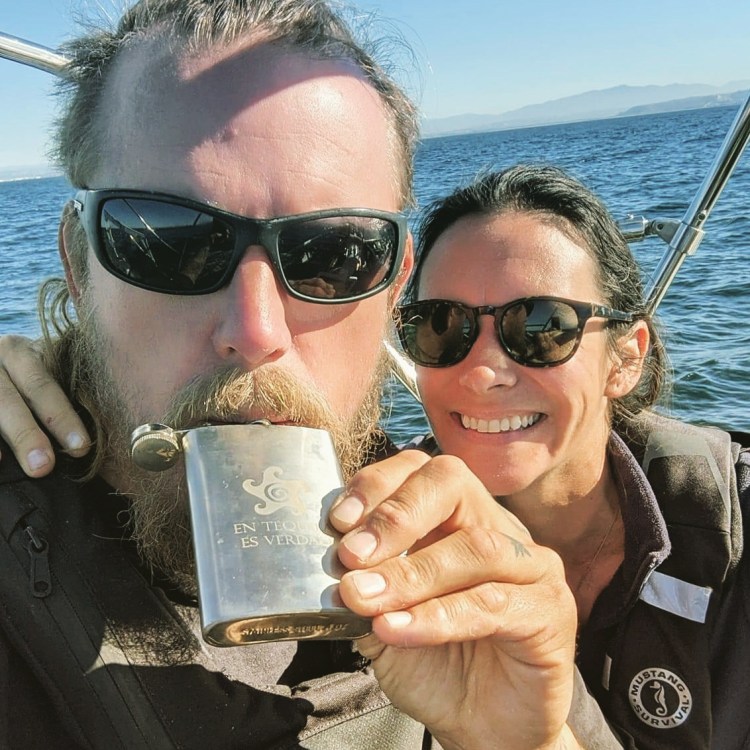
Celebrating our crossing into Mexican waters

(repping Roger Clyne and the Peacemakers with our “en tequila es verdad” flask)

Moonrise over Ensenada

My hat plus bird poop

My computer, sprayed in bird poop

Puerto Ensenada

The Sanitation Tunnel

The resident marina ducks

Our leaky fuel pump

Our fuel pump disassembled by José

Rob getting ready to eat some tacos–a fresh fish taco costs 20 pesos (about one U.S. dollar)

Our neighbors (the sea lions)–featured here are Viejo (old man) and One-Eyed Jack.

https://leakylittleboat.com/wp-content/uploads/2020/12/img_6897.mov

Our neighbors can be quite noisy, but we have grown to like it

Mapache at home in her Ensenada marina

How to be Invincible

A childhood diet of superheroes, Nancy Drew, and Harrison Ford (he played Han Solo and Indiana Jones) instilled a dream of invincibility in young me.  It wasn’t until this adventure that I thought about what invincibility really means.  It is not an innate characteristic that ensures you are bulletproof or will never lose.  It is something that is grown from the injuries and losses.  Almost every superhero story involves the hero overcoming a major life challenge before attaining their super status.  

In terms of Mapache’s journey, experiencing and solving problems has given us the knowhow to solve things like leaking thru-hulls, running aground, seasickness, mystery oil leaks, failing dinghy outboards, and, now, broken propeller systems.  And as we learn to effectively solve more problems, we get closer to invincibility.  We will never be bulletproof or devoid of problems, but we might be able to attain the experience and knowledge to ensure that those obstacles will not stop us.  

Our most recent obstacle was our driveshaft (the part that turns the propeller, much like a driveshaft that turns the wheels on a car). The piece holding the driveshaft to the transmission (the coupler) failed, leaving us drifting off of Point Conception and eventually requiring us to tow Mapache into Santa Barbara Harbor. Specifically, the key, which ensures that the coupler does not spin without gripping and turning the driveshaft, had sheared off. The key is a specific shape—square and long, fitting in similarly-shaped keyways in the shaft and the coupler, which encase the key when everything is fitted together. In boats, the key is traditionally made from bronze, a soft metal. We later learned that bronze is used as a safety measure to allow the key to shear if the propeller is suddenly stopped, for example, by kelp wrapping it, ensuring that the transmission is not harmed from the force. All that said, we needed to find a replacement key.

After towing Mapache into the Santa Barbara Harbor, we set out to find a new key.  The marine supply store did not sell them, and we held our breaths as we walked down the hardware aisle of Ace.  To our relief, Ace Hardware offered an entire box of different-sized stainless-steel keys.  We bought several, returned to the boat, and started the repair. 

In order to access the coupler, Rob had to remove the cockpit drain hoses, the exhaust hose, the sea strainer, the exhaust pipe, and the water muffler and its support board from the engine “room,” which is less of a room and more of a crawlspace under the cockpit.  Engine work on Mapache is not for the claustrophobic or inflexible.  Rob had to fold himself in half and work in an area next to his feet for the transmission, coupler, and driveshaft repairs.

He discovered that the key was not just sheared, but the keyways were mangled (likely from Rob jury-rigging it on our passage to Santa Barbara by jamming a bolt into it).  But he filed the keyways and new key to make a perfect fit.  He put everything back together and tested it against the dock, putting the boat into forward and then reverse.  Everything worked, and the next day, we cast off the lines to head south to our next destination. 

As you might recall, a giant and expensive catamaran was docked behind us.  On the morning we cast off, the wind was pushing the boat toward the catamaran.  Seeing that Rob was unable to drive the boat forward to counter the wind, I grabbed onto the lines to pull us back onto the dock as he yelled that the propeller was not working again.  The wind had pushed the bow out and the stern over the dock, hooking our windvane onto a dock cleat.  (The windvane is a manual auto-pilot that uses the wind to maintain a course and is permanently attached to the boat.) That prevented me from pulling the bow back into the dock.  Rob was forced to grab the hacksaw and cut one of the stainless steel rods off of the windvane.  The alternative was to allow the boat to spin around and into the catamaran.

It turns out that when we tested the engine in reverse against the dock before leaving, the force of the propeller pulled the driveshaft back.  Two set bolts that work with the key to hold the coupler to the driveshaft also prevent that backwards driveshaft movement.  What we did not realize before is that the same act that sheared the key also wore off the ends of the set bolts, allowing them to slip along the driveshaft.  When the shaft slipped in reverse, it allowed the key to escape the coupler and, again, eliminated use of the propeller.  

We were back to having an undriveable boat in the Santa Barbara Harbor, which was costing us $46 per day, and would increase to $92 per day if we stayed longer than two weeks.  Rob took the driveshaft and coupler apart again, saw the problem with the set bolts, and realized that the underlying problem was that the driveshaft and engine were out of alignment due to damaged motor mounts.  The repair necessitated lifting the engine to replace the mounts, replacing the coupler, aligning the engine to the driveshaft, and hopefully not ruining the seal around the driveshaft, where it exited the boat and connected to the propeller.  We spoke to several people, and learned that the only boat mechanic in Santa Barbara was booked for three months.  We received the advice to tow Mapache into the ocean and attempt to sail her to a place where we might have more options.  The advice was accompanied by the warning that, to do otherwise, would lead us to being marooned in Santa Barbara, especially because the exponentially increasing slip fees would drain our funds long before we could pay for the necessary repairs.   

There was nothing left to do but pull on our coveralls, order new motor mounts and a new coupler, and brainstorm how to hoist the engine by ourselves with the boat in the water.  

Our friend’s parents (who we now count among our growing group of Santa Barbara friends) allowed us to use their address for the parts delivery, which we received within days through overnight shipping.  We ate about $200 in overnight shipping fees, but it made financial sense when weighed against the cost of another week’s slip fees.  We built a brace over the companionway using four 2×4 boards screwed together and resting on two different surfaces.  To the boards, we tied Dyneeema rope, which has a 27,000-pound breaking point.  And to that, we attached a chain come-along (hoist) rated to lift up to a quarter-ton.  We lifted half the engine at a time, replacing the forward two motor mounts followed by the aft two.  We carefully pushed the driveshaft through its seal and out the back of the boat, allowing Rob to remove and replace the old coupler.  But the coupler is built to be press fit, meaning its opening is smaller than the shaft so that it must be pressed on by machine or heated to an extreme temperature to fit.  Without the special machinery and the boat out of the water, those are not options.  Rob centered his inner MacGyver to create his own handheld machine from sandpaper and a cordless drill.  He sanded the inside of the coupler until it fit onto the shaft.  He used a file to clean the keyway in the driveshaft and shape the keyway in the new coupler to a perfect fit for the key.  Then, he used a Dremel tool to grind two new dimples into the shaft for the new set bolts.  He safety wired the set bolts to ensure that vibrations would not loosen them.  And finally, he spent hours aligning the engine to the shaft, which had to be within a .003-inch difference around the entire coupler-shaft fitting.  Each step felt like a new obstacle and, to top it off, we discovered and resolved an exhaust leak and missing shaft and propeller zincs.  But, with the help of homemade cookies from our friend’s parents and nephew, we endured.  

We finally set out from Santa Barbara one day before our slip rates increased.  As we headed through the night toward San Diego, we heard the sound that we heard the night the propeller failed.  After swiftly switching into neutral, and with our hearts in our stomachs, we saw violent splashing around the back of the boat from a huge piece of kelp.  It had wrapped our propeller, stopping it, and we did not have the breakaway bronze key to protect our transmission.

We checked the transmission, coupler, and driveshaft.  All looked good.  We dangled over the boat’s side with a flashlight and a boat hook, pulling pieces of kelp off of the propeller.  I offered to jump in and cut off the rest, but Rob assured me the water temperature would gift me hypothermia.  So, after pulling enough of the kelp off to gingerly motor into the closest harbor, we anchored for the night.  

The next morning, we found a dive shop, and Rob bought a wetsuit.  He dove under Mapache and cleared the kelp perpetrator.  

We are back on route, having made it to San Diego on Thanksgiving Day, two months and three weeks after we left the mouth of the Columbia River and our home state of Oregon.  We are six weeks behind our planned schedule.  But, if you want to be invincible, you have to embrace the obstacles.  Next stop: Mexico.

New key on the left; original, sheared key on the right

Box of keys at the hardware store

Old coupler with mangled keyway

Broken motor mount, visible as the motor is being hoisted

Rob bringing home the wood to make the engine hoist

The new coupler and motor mounts

Engine hoist set-up

Cookie delivery to boost morale

Makeshift machining of the new coupler

Filing the new key to fit

Kelp-wrapped propeller

Rob diving to free the propeller of kelp

We made it to San Diego!

Mapache sitting amongst the boats in San Diego’s cruisers’ anchorage

Assholes and Elbows

One of the best things to come out of our journey so far is consistent evidence that people are good.  We have experienced unsolicited kindness in every place that we have stopped.  Complete strangers have loaned us their marina keys until we were able to attain our own, offered use of their vehicles, helped push us off of or pull us onto a dock in strong current and wind, dropped off a bottle of wine just to say, “welcome to their city,” divulged their secret anchoring spots, bought us meals, and become our biggest supporters.  The Humboldt Yacht Club let us use their clubhouse for our NPR interview, and the Point San Pablo Yacht Club allowed us to keep our boat at their guest dock for two weeks so that we could attend Rob’s father’s memorial.  We’ve made new friends over impromptu happy hours and hometown tours, as well as while pushing Mapache into the Santa Barbara Harbor.

The last boat log left us anchored without use of our propeller.  Despite lack of sleep from the previous two days’ passage, we were up early motoring our dinghy into the harbor.  We spoke to Santa Barbara Harbor Patrol, who were immediately understanding of our circumstance.  They secured us an end-tie (the easiest spot to dock in a marina).  Our assigned end-tie was directly in front of Warren Buffett’s partner’s mega-yacht, a massive and immaculate catamaran that holds 149 passengers.  Our plan was to use our dinghy with its outboard engine to push Mapache off anchor, around the wharf pier, through the buoy-marked channel, into the harbor, and tie up while avoiding the dozens of paddle boards, kayakers, small and large sail and motor boats, and that mega-yacht.  I would steer and Rob would captain our “tug boat,” the dinghy.  As we rode back to Mapache on the dinghy, its engine started failing.  It would take several pulls to get it running again, but it was clear that it was now unreliable.  Trouble enjoys company, I suppose.  

As we sat on Mapache contemplating what to do next, a dinghy holding three people drinking cocktails, one of whom wore a pirate hat (it was Halloween), motored alongside us.  They called out and threw us a couple of breakfast sandwiches and two White Claws.  It turned out that the pirate was my mother’s friend’s son, Matt.  He and his family have a sailboat in the harbor and live in town.  Having known them for all of two minutes, they gave us no alternative to them helping push Mapache with their dinghy.

Matt traded his passengers for his teenage son, Shane, and the two of them gripped onto Mapache’s port stays while standing in and motoring their dinghy.  Rob pushed the nose of our dinghy against Mapache’s stern.  We easily made it off anchor and were underway with enough momentum for me to steer from Mapache’s helm.  Our dinghy’s motor repeatedly gave out, leaving Rob behind, but Matt and Shane provided enough power alone.  Shane and Matt got rocked in wind waves, took water over their dinghy’s bow, and were yanked around as they held tight.  But they never let go of Mapache.  We successfully navigated the channel and into the marina, with some help from Chris, Matt’s wife, paddleboarding ahead and warning people not to cross in front of us.  Rob caught up to push Mapache again, so Matt sped ahead and dropped Shane on the dock to catch lines.  Matt stood by in his dinghy to help adjust Mapache’s positioning as needed.  Harbor Patrol also stood by, sensibly positioning their boat between our assigned dock and the giant catamaran.  My focus in the marina was on that catamaran, telling myself, “just don’t hit that!”  We gracefully pulled alongside the dock, Shane caught our midship and stern lines, and a harbor patrol officer caught our bow line.  We tied off, and it was a smooth success.  If it wasn’t for my excessive thanking of everyone, we might have looked like professionals.   

Knowing Matt, Shane, and Chris (and later, Matt’s and Chris’s daughter, Quinn) is an honor.  They are the type that see a way to help another and jump in, no questions asked.  They take away any awkwardness in the situation, providing easy confidence and positivity.  We have found that there are a lot of people who want to help others, but only some of those people take steps to do so, and even fewer keep at it no matter how much worse the problem develops.  Rob describes the people who help others and see a job to the end as people who are willing to jump in, “assholes and elbows.”  The term comes from his navy days and is a compliment.  Urban Dictionary defines the slang term as “working hard at a task,” allegedly originating from farm work, where “[i]f a group of field hands are busy and bent over picking crops, then a supervisor looking out over the group would see nothing but ‘assholes and elbows.’”  Matt, Chris, and Shane are those “assholes-and-elbows-type” helpers.  To top it all off, they also left us a six-pack of local, craft beer in our dock box.  

We are thrilled to have made so many new friends and seen the good parts of human nature.  But we definitely have not forgotten our old friends and family.  They also keep us going, sending us a spontaneous messages of encouragement, answering our calls in the middle of a workday to provide a second opinion on the forecast or a boat repair, visiting us when they can, accepting countless packages for us, and so much more.  Thank you, new friends and old, for being part of our journey.  

Now, it’s time to repair the boat!

Matt and Shane–our heroes

Sarah steered as Rob pushed Mapache with our dinghy.

Matt and Shane (while wearing a pirate hat) pulled Mapache into the harbor.

We carefully docked in front of Warren Buffett’s partner’s giant catamaran.

Matt, Chris, Shane, and Quinn left us a surprise six-pack in our dock box.

Cheers to a truly special Saturday afternoon!

Making Memories

A friend of mine told me a story about her friend, an experienced river rafter, taking another friend out on a particularly rough river.  At one point in the trip, the seasoned boater asked the friend, “Are you having fun?”  His response was, “No, but I’m making memories.”  

That statement is universally applicable.  It is the hard times that stick with us most, that teach us lessons, that are the bases of our best stories, and, as cliché as it is, make the good times better.  We don’t remember the details of the perfect, smooth days, but we remember with excruciating detail the difficult days.  The climbing community often talks about the three levels of fun. Type 1 fun is an activity that is fun while doing it: bike-riding the boardwalk, a non-strenuous hike with consistently beautiful views, margaritas.  Type 2 fun is an activity that is not enjoyable while doing it, but the accomplishment of it is enjoyable: an ultramarathon, alpine climbing.  Type 3 fun is an activity that is neither fun while doing it nor in its accomplishment.  It is the activity that is described with the phrase “I’ll never do that again.”  Still, many of us undertake activities that skirt the line of Type 2 and Type 3 perhaps because, over time, the Type 3 activities become the memories we treasure the most—the ones we regale others with around the campfire or at the pub.

Sailing can span all three types of fun, and our last passage pushed through the threshold of type 3.  

We casually set out from Morro Bay, California, in the early afternoon.  The sun was shining and the wind was blowing at 10-to-15 knots, giving us an easy push in the right direction.  We enjoyed the peace of the engine’s silence and a steady 7 knots towards our next destination, Santa Barbara.  We passed through hundreds of dolphins jumping and splashing, from our boat to what seemed like the horizon.  The wind started to drop in the evening, so we powered up the engine.  As we approached Point Conception, ominously described in our chart book as “the Cape Horn of the Pacific,” the engine suddenly revved.  We instinctively slammed it into neutral and assessed.  Seeing nothing obvious, we tried putting it back in gear and pushing on the throttle.  It revved extremely, and we saw that the propeller was not turning.  Before leaving Morro Bay, Rob had told me to make sure he changes the transmission fluid when we get to San Diego.  He started blaming himself for not doing so earlier.  The only thing that made sense was a transmission failure.  

Luckily at that moment, the wind picked up (with the waves) and we slammed through the water with mother nature’s throttle.  As we rounded Point Conception, that throttle went to zero and we were left bouncing around the swell with no engine and no wind power.  With 50 miles left to Santa Barbara, all we could do was hand-steer the boat in an effort to keep it pointed toward our destination.  Our speedometer flashing between .56 and .00 knots.  We put out a “sécurité” call on the distress channel of the VHF, notifying the Coast Guard and other boats that we were dead in the water, meaning we could not maneuver out of another boat’s way.  

The bobbing, .00-to-.56 speed persisted all night as we took turns at the helm.  Boats do not have steerage without speed, because it is the flow of the water over the rudder that forces them to turn.  With no speed to speak of, we had to harness the swell and current forces in a feeble attempt to direct the boat to the compass direction that put us on the most direct course.  The helm position was a concentration test: staring at the compass direction number on a digital screen and gripping the wheel to make minute adjustments, while engaging all core muscles to counter each drastic rock of the boat in the swell.

At sunrise, we started calculating how long it would take to get to Santa Barbara.  Both delirious because the continual slamming over the swell shook us awake each time we closed our eyes while off-duty, we guessed 40 hours or more.  We had plenty of food, and the current seemed to be pushing us in the right direction.  But the forecast showed no wind for several days.  The whispers of wind we felt continually shifted, so that anytime we tried to put up our sails, they just flapped back and forth.  Our true threat was extreme exhaustion.  Facing 40 plus hours without sleep, taking turns to desperately hand-steer the boat toward our destination, seemed inconceivable.  


Another huge pod of dolphins swam by.  We called out to them, still able to joke, “Hi, guys! Can you give us a push?”  With that, Rob decided to reevaluate the engine in the morning light.  After several minutes he popped up, and exclaimed, “We are going to drive this boat!”  It was not the transmission after all, but the piece holding the drive shaft to the transmission.  A special “key” required to hold the two together had somehow sheared off, but Rob was confident he could make a new one that would temporarily work.  His first attempt was very temporary, lasting only five minutes before a squeaking noise exploded into extreme revving of the engine. But Rob was not dissuaded.  

On his third attempt, we decided to drive the boat slow, where the squeaking noise did not develop.  We were left traveling at 2 knots under engine power.  It was still not enough to overcome the swell playing with us like a cat plays with a toy, and it required that we maintain extreme attention at the helm to stay on course.  But we were traveling more than twice as fast as before.  We continued like this through the day and into our second night, fearing the return of the squeaking noise, taking shifts, testing our ability to focus, and failing to sleep.  I sang songs to myself, but all of the lyrics were the same: “Stay together, stay together, hold tight, get us to anchor tonight.”  

Finally, we saw the lighted buoys marking Santa Barbara Harbor.  The anchorage was just past that, and we turned in.  Yelling at each other about boats and buoys in the dark, we found a spot and anchored.  But we felt too close to the boat next to us.  We decided to raise anchor and try one more time.  As Rob put the boat into gear for the second attempt, the engine revved loudly and he yelled, “just drop it here.”  But without use of the engine, we could not properly set the anchor.  Fearing the worst in a passage that seemed to be ruled by Murphy, we offloaded our dinghy.  Rob stood in the dinghy as I lowered its outboard motor from Mapache’s deck.  The swell caused the motor to swing wildly from the line that was holding it.  Rob grabbed on, and in the trough of a wave, I quickly lowered the motor.  Rob attached it before it could be swallowed up in the crest of the next wave.

By midnight, Rob was towing Mapache against her anchor to set it as well as we could.  And by 12:15 we were both asleep for the first time in almost two days.  That passage was not fun, and its accomplishment was not fun, but … we made memories.

You may be wondering how we get off the anchor or how we repair the engine.  That deserves its own log, which will post next.

https://leakylittleboat.com/wp-content/uploads/2020/11/dolphins.mov

Hundreds of dolphins swam and jumped around us as we approached Point Conception.

This broken key prevented our engine from turning the drive shaft and the propeller.

Rob worked on a temporary engine fix at sea. This is a view through our companionway stairs. Rob has to work from the space underneath the cockpit.

The sunset was beautiful on our second (unplanned) night at sea.

The morning after, we were happy to have made it to sunny Santa Barbara.

Exit mobile version